How Child Support Is Decided
Child support is money one parent may be ordered to pay to help cover a child’s basic needs. This guide explains the usual factors courts look at, what papers may matter, and when it may help to speak with a licensed family lawyer.
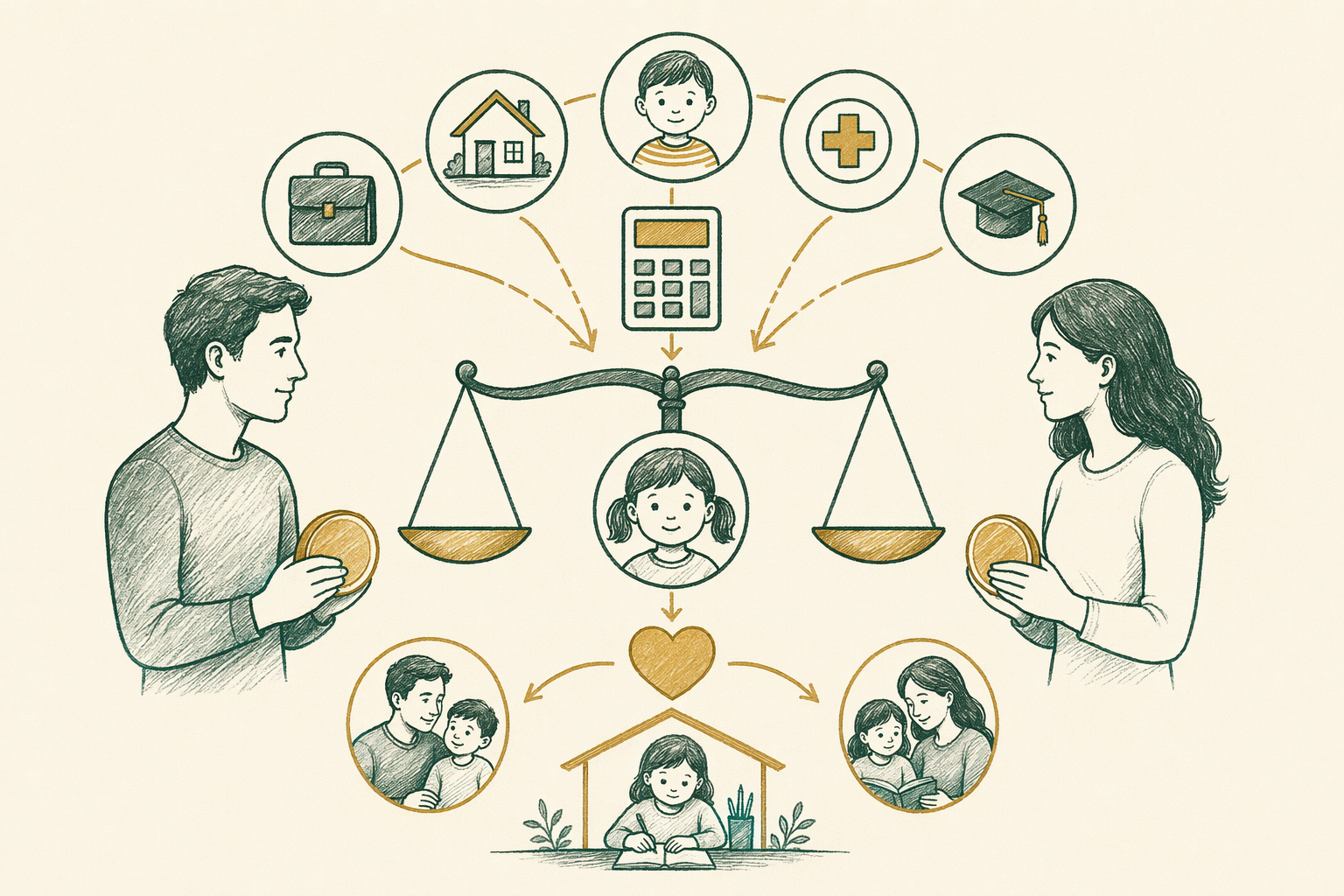
What child support means
Child support is money paid by one parent to help pay for a child’s needs, such as housing, food, clothing, school costs, and health care. A court order is a written decision from a judge that says who pays, how much, and how often.
In most states, child support is based on a formula. A formula is a set method the court uses to calculate support. The court usually starts with numbers like each parent’s income, how many children need support, and how much time the child spends with each parent.
The goal is to support the child, not to punish either parent. Even if the parents were never married, a court may still order child support. Rules vary by state and your situation.
What courts often look at
- Each parent’s income, including wages, self-employment income, and sometimes bonuses or tips
- How many children need support
- Parenting time, meaning how many overnights or how much time the child spends with each parent
- Health insurance costs for the child
- Work-related child care costs, such as day care needed so a parent can work or go to school
- Other court-ordered support, such as support for another child in some states
- Special needs or unusual expenses, if state law allows the court to consider them
How the court calculates support
Many states use child support guidelines. Guidelines are the standard rules and math used to set support. Some states combine both parents’ incomes and estimate what parents at that income level usually spend on children. Other states look more directly at the paying parent’s income.
The court may count gross income or net income, depending on state law. Gross income means income before taxes and other deductions. Net income means income after certain deductions. This is one reason the amount can differ a lot from state to state.
A judge can sometimes change the guideline amount. This is called a deviation. A deviation means moving away from the usual formula because of special facts, such as very high medical costs, unusual parenting schedules, or a parent who is intentionally not working. Judges usually need a legal reason to do this.
If a parent has little or no income, the court may still set a payment. In some cases, the court may assign income based on earning ability. This is sometimes called imputed income. It means the court believes the parent could earn more than they currently report. A licensed attorney can explain how your state handles this.
Documents that may be important
- Gather proof of income, such as pay stubs, tax returns, benefit letters, or profit and loss records if you are self-employed.
- Collect records for the child’s expenses, including health insurance, child care, school costs, and medical bills.
- Make a list of the child’s usual schedule, including overnights with each parent.
- Bring any existing court orders, including custody, divorce, or protection orders.
- If your income changed recently, gather proof, such as a job loss letter, reduced hours notice, or new employment records.
- If English is not your first language, ask the court or lawyer about interpreter help. An interpreter is a person who translates spoken language.
Be careful with informal agreements
If one parent lives in another state or country
Child support can still be decided when parents live in different places. Usually, one state will have the power to issue or enforce the order. Enforce means to make sure the order is followed. Which state has power can depend on where the child lives, where a parent lives, and whether there is already an order.
International cases can be more complicated. If one parent lives outside the United States, the court may need extra steps for notice, service, or enforcement. Service means formally delivering legal papers. Some countries work with U.S. states more easily than others.
For immigrants, there can also be worries about language, address changes, and missing court dates. It may help to keep copies of all notices and ask for translated help when possible. You can also read more about family law help at services for family matters or use the free lawyer matching service if you want to talk with a licensed attorney.
Can child support be changed later
Yes, often it can. A change is usually called a modification. A modification is a new court order that updates the old amount. You normally must ask the court for this. The change is not automatic.
A court may consider a modification if there has been a major change, such as job loss, a big income increase, a new parenting schedule, or changes in the child’s health insurance or child care costs. Some states also allow a review after a certain amount of time.
It is important not to just stop paying because your situation changed. Unpaid support can build up into arrears. Arrears means past-due child support. Arrears may lead to serious collection steps, such as wage withholding, tax refund interception, or license problems, depending on state law.
If you think the amount is wrong, or if the other parent is hiding income, general information can help you prepare, but legal advice should come from a licensed attorney who knows your state’s rules.
Common questions
Does the parent with more custody always get child support?
Not always. Courts often look at income and parenting time together. In some cases, even with shared custody, one parent may still pay support if there is a big income difference.
What if the other parent works for cash or hides income?
The court may look at other proof, such as bank records, spending patterns, work history, or testimony. A judge may also assign income based on earning ability in some situations. Rules vary by state and your situation.
Can we agree on our own amount?
Parents may make an agreement, but many courts still need to review and approve it. If the court does not approve it, the agreement may not be enforceable. It is safer to ask a licensed attorney how your state handles this.
Will child support affect immigration status?
It can raise concerns in some cases, especially if there are missed court dates or unpaid support. Immigration and family law can overlap, so it may help to speak with a licensed attorney for advice about your specific situation.
How can I find a lawyer if I am worried about cost or language?
Legal Bearings offers free help to get matched with a participating licensed attorney. Legal Bearings is not a law firm and does not give legal advice. It is a flat-fee matching service paid by participating attorneys, and cost ranges for legal help vary by state and your situation.
In plain English: Child support is usually based on a state formula using income, child-related costs, and parenting time, and a licensed lawyer can explain how your state applies those rules.