Petitioning for a Family Member: An Overview
If you are a U.S. citizen or lawful permanent resident, you may be able to ask the government to let certain relatives immigrate. This guide explains the basic process, common problems, and when it may help to speak with a licensed immigration lawyer.
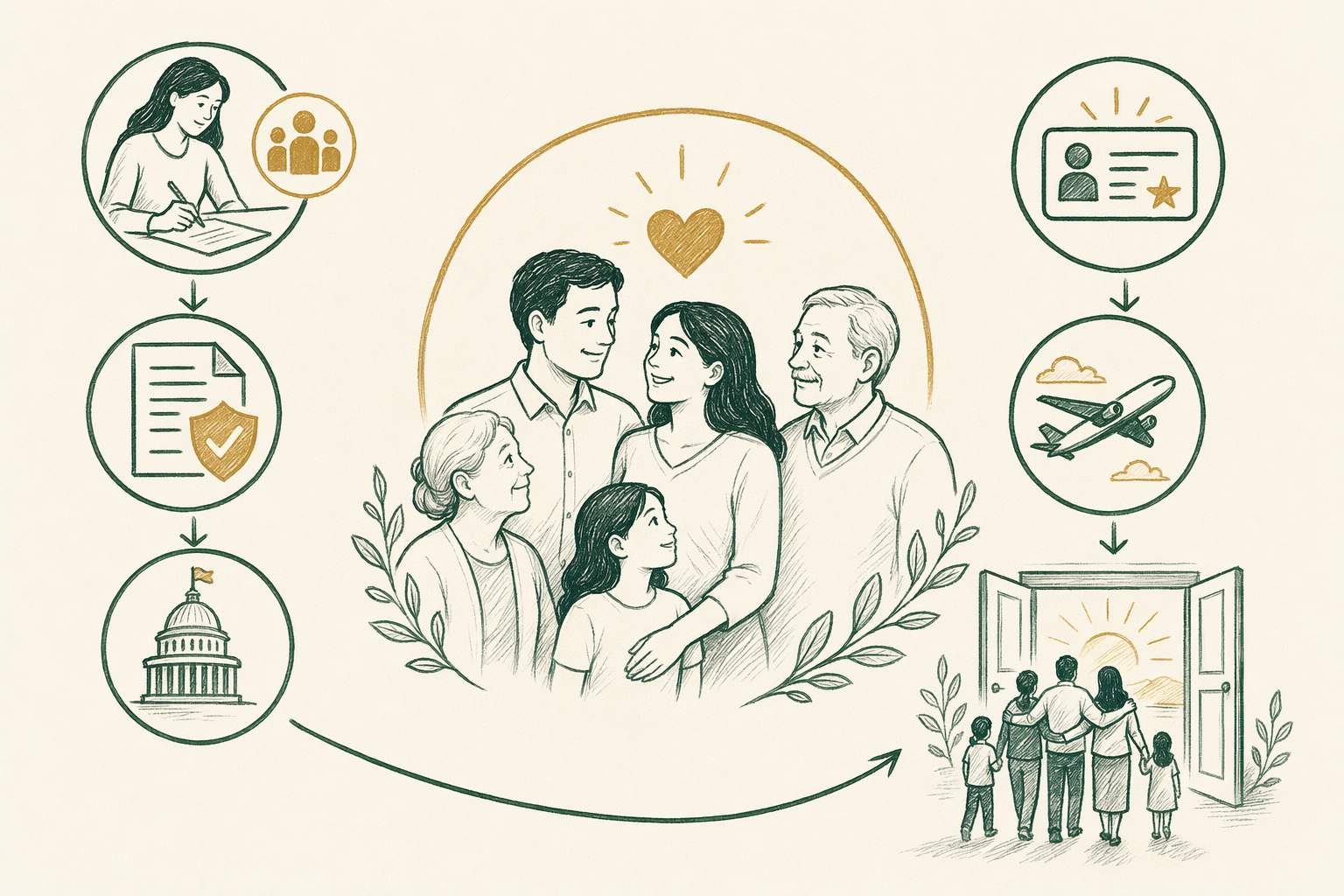
What petitioning for a family member means
Petitioning for a family member means asking the U.S. government to recognize a qualifying family relationship for immigration. A petition is a formal request. In many cases, the first form is Form I-130, also called a Petition for Alien Relative.
The person who files is usually called the petitioner. The family member they are asking for is often called the beneficiary. Filing a petition does not give a green card right away. A green card is proof of lawful permanent resident status, which means a person can live and work in the United States permanently.
Who may qualify depends on your immigration status and your relationship to the relative. U.S. citizens can usually petition for more kinds of relatives than lawful permanent residents, who are also called green card holders. The rules can be strict, so it is important to understand the basics before you pay fees or send forms.
Who may be able to petition, and for whom
- A U.S. citizen may often petition for a spouse, unmarried child, married child, parent, brother, or sister.
- A lawful permanent resident may often petition for a spouse or unmarried child.
- Some relatives are called immediate relatives of U.S. citizens. This usually includes a spouse, an unmarried child under 21, or a parent of a U.S. citizen who is at least 21.
- Other relatives fall into family preference categories. These are groups with annual limits, which can lead to long waits.
- Stepchildren, adopted children, and some other family relationships may qualify, but special rules often apply.
- A fiancé or fiancée uses a different process than a family petition after marriage. That is not the same as a standard I-130 case.
How the process usually works
First, the petitioner sends forms and supporting documents to U.S. Citizenship and Immigration Services, often called USCIS. Supporting documents are papers that help prove your case, such as birth certificates, marriage certificates, passports, divorce records, or proof of U.S. citizenship or permanent resident status.
Next, the government reviews whether the family relationship is real and legally valid. If USCIS approves the petition, that does not always mean the person can move forward right away. Some relatives can continue immediately. Others must wait until a visa is available. A visa in this setting means permission under immigration law to immigrate through a specific category.
The next step depends on where the family member is and whether a visa is available. If the relative is in the United States and qualifies, they may apply for adjustment of status, which means asking to become a lawful permanent resident without leaving the country. If the relative is outside the United States, they may go through consular processing, which means applying through a U.S. embassy or consulate abroad.
Many cases also involve a medical exam, fingerprinting, background checks, and an interview. Times can vary a lot. They depend on the family category, the country of chargeability, the person’s immigration history, and current government processing backlogs.
Basic steps to petition for a family member
- Check whether your relationship qualifies under immigration law.
- Confirm your own status, such as U.S. citizen or lawful permanent resident.
- Gather documents that prove the relationship and any prior marriages or name changes.
- File the correct forms with the right government agency and fee.
- Track the case and respond quickly to any government notice asking for more evidence.
- If the petition is approved, find out whether the relative can apply now or must wait for a visa number.
- Prepare for the next stage, such as adjustment of status in the U.S. or consular processing abroad.
- Consider talking with a licensed immigration attorney if there are past visa problems, unlawful presence, criminal issues, missing documents, or questions about eligibility.
Common mistakes can cause delays
Common problems and special issues
Some family cases are simple. Others are not. Problems often come up when records do not match, a marriage happened soon after a prior divorce, a child’s age matters, or the relative entered the U.S. without inspection. Without inspection usually means entering the country without being formally admitted by an immigration officer.
There may also be concerns about fraud, prior removal orders, unlawful presence, or certain criminal history. Unlawful presence means time in the U.S. without legal permission, which can trigger bars to reentry if the person leaves the country. In some cases, a person may need a waiver, which is a request asking the government to forgive a ground of inadmissibility. Not everyone qualifies.
Money issues can matter too. Many family-based green card cases require an affidavit of support. This is a legal promise by a sponsor to show enough income or assets to support the immigrant. If the petitioner does not meet the income level, a joint sponsor may sometimes help.
Because the facts matter so much, general information can only go so far. If your case involves overstays, prior denials, immigration court, or arrests, it may help to speak with a licensed immigration attorney before filing. You can also learn more about immigration legal help and how free matching works.
How to protect yourself from scams and bad help
Immigration scams are common. Be careful with anyone who promises fast approval, guaranteed results, or a secret way around the rules. No honest person can promise an outcome.
In many communities, a notary from another country may help with paperwork. But in the United States, a notary public is usually not a lawyer and cannot give legal advice unless they are also a licensed attorney or accredited representative. Using the wrong helper can cost time and money.
Ask who will handle your case. Ask what services are included. Get the fee agreement in writing. Keep copies of everything you sign and submit. If English is hard for you, ask for an interpreter or translated explanations before you agree to anything.
Legal Bearings is not a law firm and does not give legal advice. It offers free information and a free way to get matched with a licensed attorney who may be able to help. The service is free to you. Participating attorneys pay Legal Bearings a flat fee for marketing, and fees for legal work are set separately between you and the attorney.
Common questions
Does filing a family petition give my relative legal status right away?
Usually no. Filing a petition starts the process, but it does not automatically give lawful status, work permission, or a green card. The next steps depend on the family category, visa availability, and the relative’s facts.
How long does family-based immigration take?
It varies widely. Immediate relative cases for U.S. citizens may move faster than family preference cases, which often have long waits. Timing depends on the relationship, the country involved, government backlogs, and whether there are problems in the case.
Can a green card holder petition for parents or siblings?
Generally, no. Lawful permanent residents usually may petition for a spouse or unmarried child. Parents and siblings are usually categories for U.S. citizens, with extra age and relationship rules.
What if my relative is in the U.S. without status?
That can make the case more complicated. Some people may still have options, while others may face serious risks if they leave the U.S. or file the wrong way. A licensed immigration attorney can advise you about your specific facts.
How much does it cost to get help with a family petition?
Lawyer fees often vary by state and your situation. Some attorneys charge a flat fee for a basic family petition, while more complex cases can cost more. Initial consultations may be free or may have a fee. If you want, Legal Bearings can help you get matched for free with a licensed attorney, so you can ask about cost and language support directly.
In plain English: You may be able to petition for certain family members, but the rules are strict, so getting general information first and legal advice for your specific case can help you avoid costly mistakes.